Free U.S. Shipping Over $75+ |
30-Day Money-Back Guarantee |
50K+ Happy Customers
Free U.S. Shipping Over $75+ |
30-Day Money-Back Guarantee |
50K+ Happy Customers
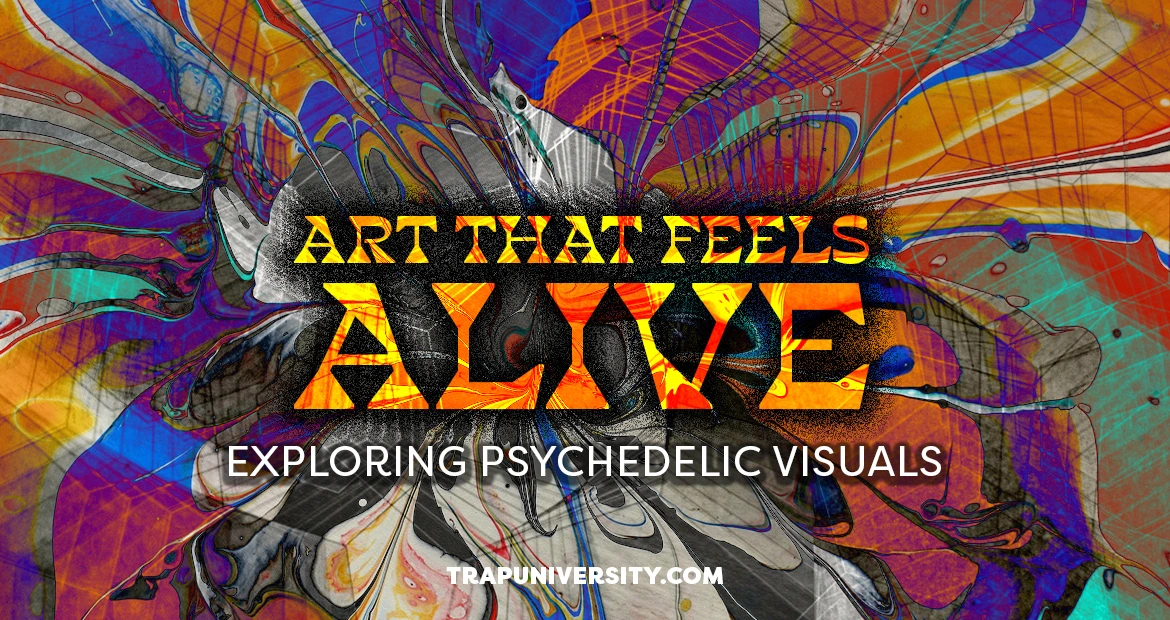
Visionary art is a visual style inspired by altered perception, expanded consciousness, vivid color, optical movement, surreal imagery, and sensory distortion. It became strongly associated with 1960s counterculture, music posters, light shows, and later evolved into digital art, festival visuals, immersive installations, fashion, and online visual culture.
Some art hangs quietly on a wall.
Psychedelic art does the opposite.
It moves. It bends. It pulses. It makes color feel louder, shapes feel emotional, and ordinary patterns feel like they’re breathing.
That is why psychedelic visual culture still connects with people today. It does not just ask you to look—it asks you to feel what looking means.
From 1960s concert posters to modern festival visuals, from album covers to AI-generated dreamscapes, psychedelic visual culture has become one of the strongest visual languages in modern culture. You see it in music, streetwear, product design, social media aesthetics, mushroom culture, and immersive digital experiences.
But where did it come from? Who shaped it? And why does it still feel so powerful?
Let’s break it down.
The modern history of **psychedelic visual culture is closely tied to the 1960s counterculture movement.
During that era, artists began creating visuals that reflected expanded perception, anti-establishment energy, music culture, and altered states of consciousness. Posters, album covers, underground magazines, and light shows became the main canvas.
The Tate describes psychedelic visual culture as strongly associated with the 1960s and mind-expanding visual experimentation.
👉 Source: Tate – Psychedelic Art
This period gave psychedelic visual culture its signature style:
The goal was not realism. The goal was perception.
One of the most important figures in psychedelic visual culture history is Wes Wilson.
Wilson became known for his concert posters in the San Francisco music scene, especially during the 1960s. His posters featured stretched, distorted lettering that seemed to melt into the image. The words were not just information—they were part of the visual trip.
His work became closely connected to bands and venues associated with the psychedelic music scene, including the Fillmore era.
MoMA lists Wes Wilson as an artist connected to this influential graphic movement.
Why Wilson matters:
Without Wes Wilson, the visual identity of psychedelic music culture would look completely different.
Another major figure is Victor Moscoso, a Spanish-American artist known for his bold psychedelic posters.
Moscoso used vibrating color combinations, visual tension, and optical effects to create posters that felt almost animated. His work showed that color could create movement even when the image was still.
His approach was different because he had formal art training. He understood color theory and used it intentionally to create visual overload.
That is one reason psychedelic visual culture often feels alive: the colors are not random. They are engineered to create tension, vibration, and energy.
👉 Source: Smithsonian American Art Museum – Victor Moscoso
If the 1960s gave psychedelic visual culture its graphic identity, Alex Grey helped push it into visionary and spiritual territory.
Grey is known for detailed paintings that show human bodies as transparent energetic systems. His work often combines anatomy, consciousness, spirituality, and light.
Many people know Alex Grey through his collaborations with the band TOOL, where his artwork became part of the band’s visual identity.
👉 Source: Alex Grey Official – TOOL Collection
What makes Grey’s work important is that it does not simply show external visuals. It tries to show the inner experience:
His art asks a different question:
What would consciousness look like if you could see it?
That is why his work continues to influence psychedelic visual culture, festival visuals, tattoo design, album covers, and visionary culture.
Modern **psychedelic visual culture has moved beyond posters and paint.
Today, it lives in digital animation, projection mapping, VR environments, AI visuals, and immersive festival installations.
One of the artists most associated with this shift is Android Jones.
Jones blends digital painting, sacred geometry, visionary symbolism, and immersive technology. His work has appeared in large-scale visual environments and festival settings, where art becomes something you stand inside rather than simply observe.
👉 Source: Android Jones Official Website
Why Android Jones matters:
This is where psychedelic visual culture becomes fully immersive.
Not a poster.
Not a painting.
A world.
The reason **psychedelic visual culture feels intense is not only the color. It is the way it plays with visual perception.
Your brain is constantly trying to stabilize reality. It wants clean edges, recognizable shapes, and predictable patterns.
Visionary art interrupts that.
It uses:
This creates tension between what the eye sees and what the brain expects.
That tension can feel emotional, hypnotic, or even spiritual.
For a deeper related read, explore Trap University’s guide on perception:
👉 [Psychedelic Outdoor Experiences
You cannot separate psychedelic visual culture from music.
The relationship is too deep.
In the 1960s, posters and album covers helped shape the identity of psychedelic rock. Later, rave culture and electronic music pushed the style into lasers, projections, fluorescent colors, and moving visuals.
Today, festivals use psychedelic visuals to create full sensory environments.
Think about:
The art does not just decorate the music. It becomes part of the performance.
This is why psychedelic visual culture feels so alive in festival culture—it moves with the sound.
The psychedelic aesthetic is everywhere now.
You see it in:
Modern visual culture borrows heavily from psychedelic visual culture because it instantly communicates energy, creativity, rebellion, and sensory intensity.
That is especially true in mushroom gummies and mushroom chocolate branding, where visuals often use color, distortion, and surreal composition to suggest sensory exploration.
Explore related formats here:
The packaging and imagery around these products often reflect the same visual language that psychedelic visual cultureists have used for decades: bold colors, altered depth, and dreamlike atmosphere.
Another major theme in psychedelic visual culture is nature.
Artists often use:
Why?
Because nature already contains psychedelic patterns.
Look closely at a leaf, a mushroom cap, tree bark, coral, clouds, or flowing water. You will see repetition, symmetry, texture, and fractal geometry.
That is why psychedelic outdoor experiences often feel visually rich.
👉 Psychedelic Outdoor Experiences Guide
Nature gives psychedelic visual culture its blueprint.
Visionary art never really disappears.
It just changes format.
The 1960s had posters.
The 1990s had rave flyers.
The 2000s had digital festival visuals.
The 2020s have AI, immersive installations, and social media loops.
But the core idea stays the same:
Visuals can change how we feel.
That is why psychedelic visual culture keeps returning whenever culture becomes more interested in consciousness, perception, creativity, and alternative ways of seeing the world.
Visionary art is a visual style inspired by altered perception, vivid colors, optical distortion, surreal imagery, and expanded consciousness.
Important psychedelic visual cultureists include Wes Wilson, Victor Moscoso, Alex Grey, and Android Jones.
Bright colors create intensity, contrast, and visual vibration, helping the artwork feel more immersive and alive.
Yes. Visionary art has a deep history in concert posters, album covers, rave visuals, and modern festival stage design.
The best **psychedelic art does not just show you something strange.
It changes the way you look.
From Wes Wilson’s warped posters to Alex Grey’s visionary bodies and Android Jones’ digital dreamscapes, psychedelic visual culture continues to evolve because perception itself never stops evolving.
That is why the style still matters.
It reminds us that seeing is not passive.
Seeing is an experience.
This content is for informational and educational purposes only. It does not constitute medical or legal advice. Psychedelic legality varies by jurisdiction. Please follow local laws and consult a qualified professional when needed. Intended for audiences 21+.
No account yet?
Create an AccountPlease, verify your age to enter.
Your access is restricted because of your age.